Rocío Pérez
Occupational Therapist at Qinera
Read more posts


For people with Autism Spectrum Disorder (ASD), the world can sometimes feel chaotic, overwhelming, and difficult to predict. This difficulty in processing environmental stimuli often leads to challenges in self-regulation, which can escalate into crisis situations — the expression of a system that can no longer manage incoming input.
Traditionally, crises have been managed reactively. However, with multisensory rooms, the approach is shifting toward prevention and the development of self-regulation strategies.
Imagine a glass.
Now imagine that a person’s energy and tolerance are that glass.
Throughout the day, bright lights, changes in plans, or loud noises add drops of water into it.
A crisis (meltdown) happens when the glass becomes too full and overflows. At that point, the brain goes into “emergency mode” — it can no longer reason, it simply tries to cope with the discomfort.
In this context, sensory integration is the brain’s ability to organize those drops to prevent overflow.
As Cárcel López and Ferrando-Prieto (2024) point out, “The way we perceive and process stimuli directly influences our responses to the environment.” This explains why a stimulus that may seem neutral can be overwhelming or even painful. — Rocío Pérez, Occupational Therapist

One of the most valuable aspects of a multisensory room is that the person can interact with the environment and adapt it to their needs. In more advanced setups, such as those using SHX technology, it’s possible to change the lighting, activate bubbles, or transform the overall atmosphere with just the press of a button.
It’s even possible to synchronize all the elements in the room so they change at the same time, creating a fully immersive environment.
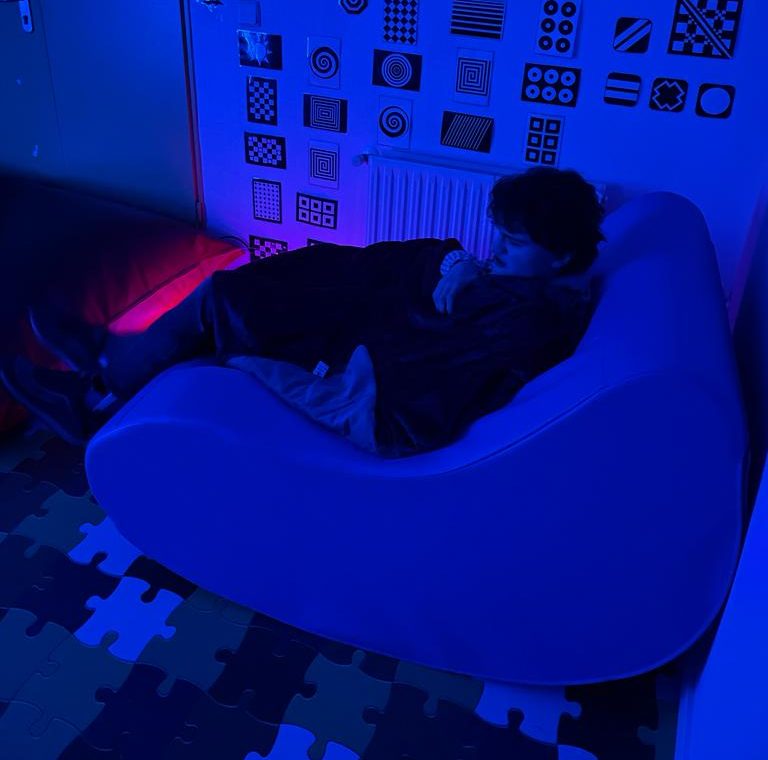
This type of interaction is not only motivating — it also holds significant therapeutic value. In moments of overload or distress, many people feel they’ve lost control of what’s happening around them.
Being able to act on the environment and see it respond immediately helps restore a sense of safety, autonomy, and control — all of which are essential for emotional regulation.
There is no single formula that fits all. Each person perceives, processes, and responds to stimuli in their own way. That’s why, for a multisensory room to be truly effective, it must be based on a deep understanding of each user’s sensory profile, preferences, and needs.

Intervention also needs to be guided by a clear intention. It’s not just about entering the room to “relax” or “have a nice time,” but about using the space with a specific purpose: preventing overload, promoting calm, supporting de-escalation, or helping reorganize after a crisis.
When the nervous system enters a state of alert, it can trigger responses such as disruptive behaviors, intense self-stimulation, shutdown or withdrawal, and emotional outbursts. This is not “bad behaviour,” but an adaptive response to overload.
In this context, a multisensory room can play a very valuable role when it is integrated into a structured support strategy. It’s helpful to distinguish three key moments of intervention:
Crises are not the problem — they are a message that the environment has become too overwhelming. The multisensory room acts as a translator, helping us understand that message and offering a pause so each person can experience the world at their own pace. — Rocío Pérez
If you want to learn more about the benefits of Multisensory Environments or see how you could adapt it to your space, therapeutic goals, and users, you can send an email to hello@qinera.com.